
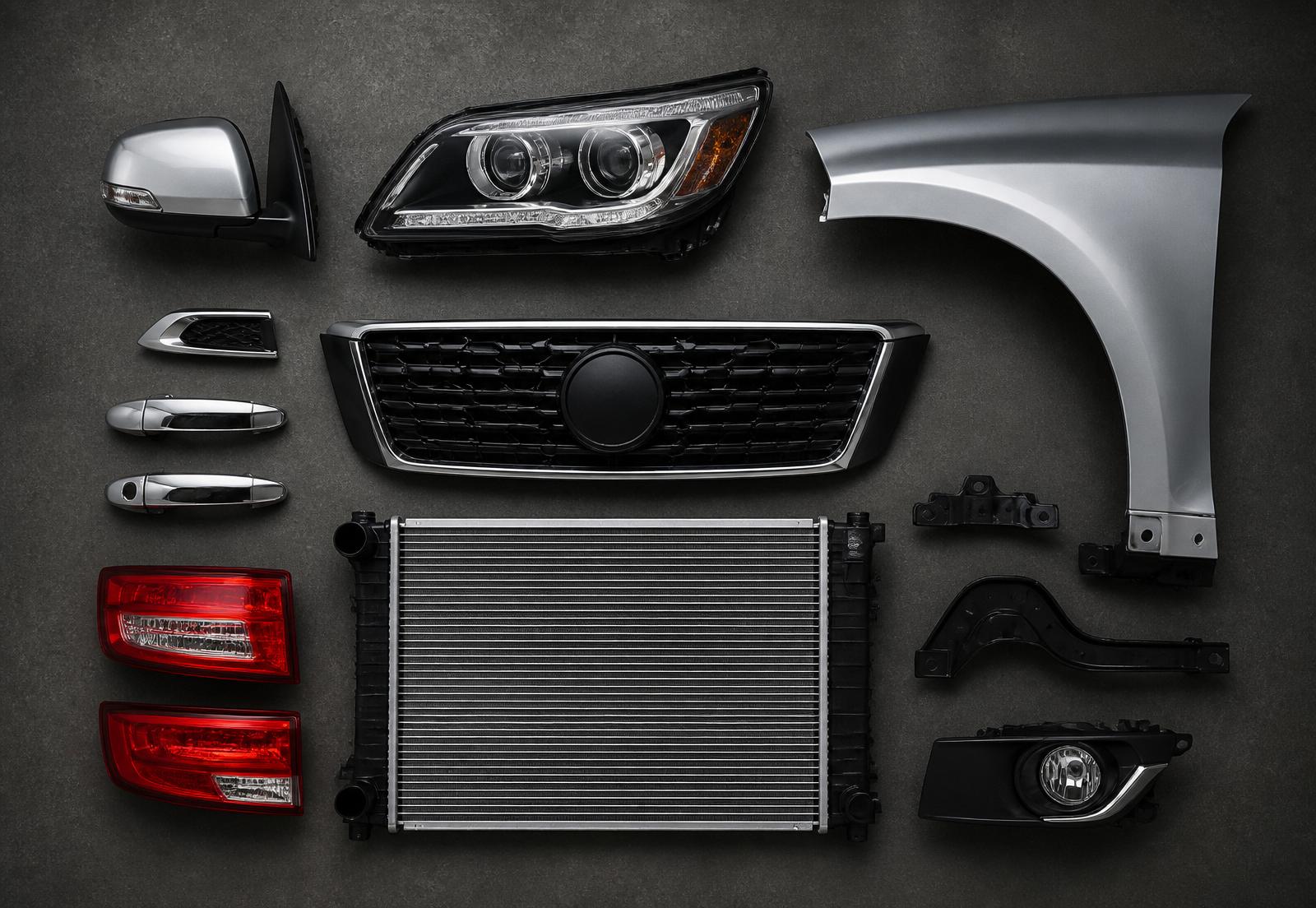
Radiators sized to keep coolant temps flat under actual Michigan summer traffic.
A radiator's job is thermal endurance, not just spec-sheet BTUs. We stock units built with the tube counts and tank geometry that hold coolant temps stable at long idles and freeway loads.
Cooling · Powertrain · Ships from Warren, MI
Aftermarket notice: This is a quality aftermarket replacement part — not an OEM component sold by the vehicle manufacturer.
Backed by the Power Auto Parts fit & finish warranty.
The radiator program at a glance
Our radiator lineup covers plastic-tank/aluminum-core units for most passenger applications and all-aluminum units for heavy-duty and performance builds. We stock with matched fittings for automatic transmission cooler ports where the OE included them.
When to swap a radiator
Coolant leaks at the tank seam
The plastic side tanks eventually crack at the crimp — a re-crimp is a bandage, not a fix.
Front-end collision damage
Bent cores lose flow area and drop heat rejection.
Transmission cooler contamination
When the internal cooler fails, the radiator and transmission both need service.
Symptoms of radiator end-of-life
A radiator rarely fails safely:
- Green or pink stain lines running down the front of the unit
- White crusty deposits at the tank-to-core seam
- Coolant loss without visible external leaks (internal cooler failure)
- Overheating in traffic with no fan or thermostat fault present
Why radiators come off
- 1Plastic tank cracking at the crimp
- 2Internal automatic transmission cooler failure
- 3Impact damage from collision or road debris
- 4Extended-service coolant neglect corroding tubes
Core and tank construction
Aluminum core
Brazed tube-and-fin core for efficient thermal transfer.
Reinforced polymer tanks
Glass-filled nylon side tanks with EPDM gasket seal.
All-aluminum tanks
Welded tanks for heavy-duty and performance applications.
How to spec a radiator
Confirm transmission type
Auto and manual radiators look similar but only one has cooler ports.
Replace hoses and clamps
Twenty-dollar hoses often outlast the radiator; if they're the same age, replace them together.
Use the correct coolant
Long-life, HOAT, and OAT coolants aren't interchangeable. Match the vehicle's spec.
Radiator questions we field weekly
- Are your radiators pressure-tested at the factory?
- Yes. Every unit is leak-checked before it leaves the manufacturer and again at our inspection station.
- Do you offer heavy-duty upgrade options?
- For select applications, yes — expanded tube counts for towing and performance use.
- Can I get a radiator delivered with hoses and clamps?
- Absolutely. Ask the counter to pull matched hoses and clamps as a kit.
Parts that often ship together.
Hold coolant flat, keep the customer moving.
Call with the VIN and transmission type — we'll route a radiator and matched hoses on the next dispatch.